Vibrocompaction design in Anchorage must follow ASCE 7-22 and IBC 2021 seismic provisions, given the region's high seismicity and prevalence of loose granular soils. The method densifies saturated sands through deep vibratory probes, reducing settlement risk and raising bearing capacity. Before proceeding, a site-specific soil profile is essential; we typically correlate data from an SPT test to determine initial relative density. In areas with interbedded silts, combining vibrocompaction with vertical drains accelerates pore-pressure dissipation. For projects requiring continuous stiffness profiles, integrating MASW-Vs30 surveys helps calibrate the vibrocompaction energy distribution across the site.
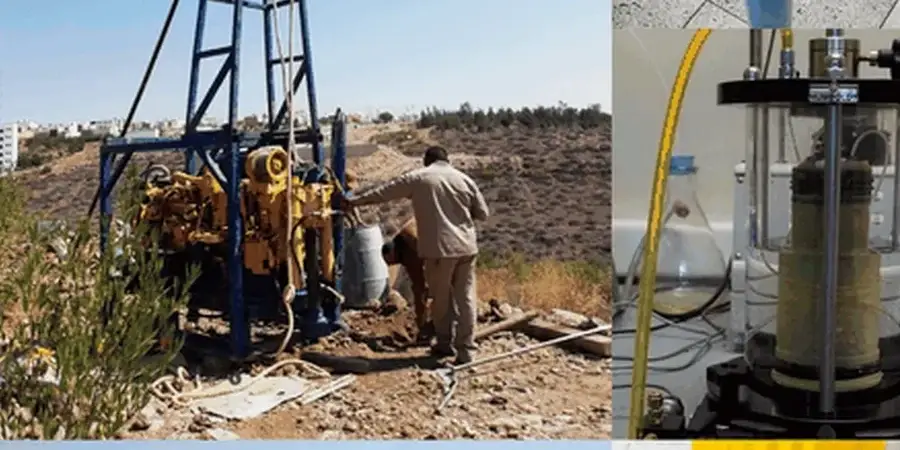
Post-treatment verification is non-negotiable: without SPT or CPT control, you cannot guarantee that the target relative density has been reached across the entire treatment zone.
Scope of work
- Borehole logging and SPT sampling to classify soil types per ASTM D2487.
- Vibrocompaction trial area with 3–5 test points to optimize probe spacing and energy.
- Post-treatment CPT or SPT verification to confirm relative density ≥70% for liquefaction mitigation.
Area-specific notes
A common mistake builders make in Anchorage is assuming that vibrocompaction alone solves all liquefaction risks. They skip the trial area and apply a standard grid from a textbook. The result is uneven densification — loose pockets remain between probes. In cold climates, frozen ground in winter introduces another variable: the soil profile changes due to ice lenses, and vibration energy dissipates differently. We have seen projects where 30% of the treatment zone failed verification because the energy was not adjusted for the presence of permafrost or ice-rich silt. That is why we insist on a phased, verified approach tailored to the actual ground conditions encountered.
Standards used
ASCE 7-22 (Seismic Loads, Site Class F criteria), IBC 2021 (Chapter 18: Soils and Foundations), ASTM D1586-18 (Standard Test Method for SPT), ASTM D2487-17 (Classification of Soils for Engineering Purposes), NCEER 2001 (SPT-Based Liquefaction Evaluation)
Linked services
Full-Scale Vibrocompaction Design & Supervision
Complete design package including site investigation, trial area optimization, probe spacing calculation, energy specification, and post-treatment verification with CPT/SPT. Suitable for large commercial or industrial pads where liquefaction risk is high.
Vibrocompaction Feasibility Study & Peer Review
Desk study and field reconnaissance to assess whether vibrocompaction is technically and economically viable for your site. Includes soil profile review, preliminary settlement estimates, and comparison with alternative Improvement methods.
Typical parameters
Q&A
How deep can vibrocompaction treat loose soils in Anchorage?
With standard vibrators (150–300 kW), treatment depths of 15–20 m are achievable in clean sands. In gravelly or cobble-rich deposits, depth may be limited to 10–12 m due to probe refusal. A trial area is highly recommended to confirm the maximum depth for your specific site.
How much does vibrocompaction design cost in Anchorage?
The range for a typical design package (site investigation, trial area, full design, and verification plan) is between US$1,530 and US$5,550. The final cost depends on site size, number of test points, and the need for additional boreholes or CPT soundings.
What relative density is required to prevent liquefaction?
For most Anchorage sites, a post-treatment relative density (Dr) of at least 70% is recommended, based on the NCEER 2001 liquefaction evaluation procedure. In areas with very strong seismic demand (PGA > 0.4g), a target of 75–80% may be required. Verification is done via CPT or SPT at a rate of 1 test per 500–1000 m².
Can vibrocompaction be done in frozen ground?
It is difficult and often ineffective. Frozen soil has high damping and low permeability, so vibration energy does not propagate well. The standard approach is to schedule vibrocompaction during the thaw season (May–October), or to pre-thaw the ground using steam injection or ground heaters if winter work is unavoidable.