Anchorage sits at 61.2°N latitude with an average elevation of 102 feet, but its underlying geology tells a more complex story. The city straddles the Cook Inlet forearc basin, where glacial till, alluvial fan deposits, and organic silts create a highly variable subgrade for road construction. Soil stabilization for roads in Anchorage must address both the seasonal frost heave and the low bearing capacity of these native soils. A typical approach combines mechanical compaction with chemical additives, but the exact design depends on the plasticity index and the depth of the seasonal thaw layer. Before any treatment begins, we run a subgrade evaluation to classify the material under AASHTO M 145, and then we cross-check the results with CBR testing to confirm the soaked strength meets design targets. This two-step screening prevents over-engineering on stable sections while flagging weak zones that need deeper intervention.
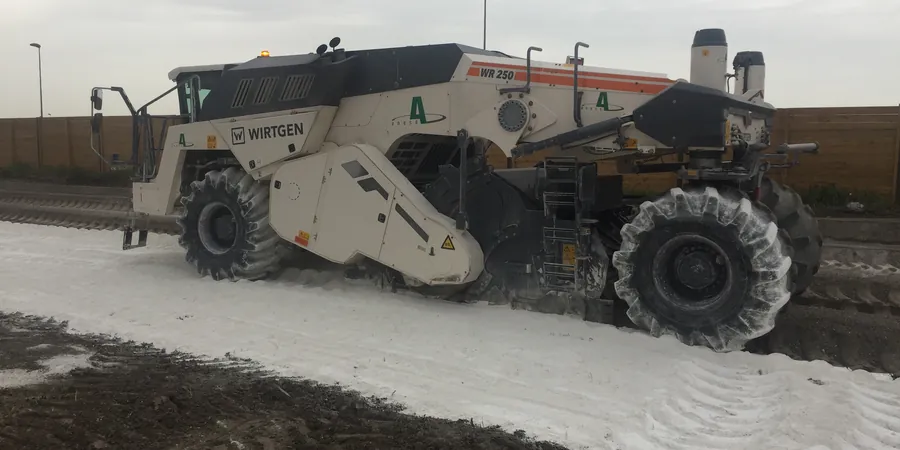
A plasticity index drop from 35 to 8 after lime treatment means the road can survive Anchorage’s freeze-thaw cycles without annual patching.
Scope of work
Area-specific notes
A common mistake among contractors in the Anchorage area is applying a uniform stabilization recipe across the entire road alignment. The Bootlegger Cove clay can vary from a low-plasticity silt near the hillside to a high-plasticity clay in the bottomland, and a single additive rate will either waste material on the low-PI sections or leave the high-PI zones under-treated. The risk is differential heave that breaks the pavement within two winters. A better practice is to run a preliminary exploration with borings at 500-foot intervals, then adjust the stabilizer dosage based on the actual plasticity index and moisture content of each segment. This phased approach costs more upfront but cuts long-term maintenance by a factor of three.
Standards used
ASTM D1586-18 (SPT), ASTM D4318-17 (Atterberg Limits), AASHTO M 145-91 (Soil Classification), IBC 2021 Chapter 18 (Subgrade Preparation)
Linked services
Subgrade Exploration and Sampling
Boreholes and test pits to retrieve disturbed and undisturbed samples from the road alignment, with field logging of soil type, color, moisture, and consistency.
Mix Design and Laboratory Validation
Atterberg limits, Proctor compaction, and unconfined compressive strength tests to determine the optimal additive type and dosage for the actual site soils.
In-Place Stabilization Field Control
Supervision of mixing depth, additive spread rate, and compaction effort; field density tests using the sand cone method or nuclear gauge to verify lift quality.
Post-Treatment CBR and Strength Verification
Soaked CBR tests on field-molded specimens and UCS tests on cores taken from the treated layer to confirm that the design targets are met before paving begins.
This service complements our laboratory testing work for a complete project analysis.
Typical parameters
Q&A
How much does soil stabilization for roads in Anchorage cost?
The typical cost for full-depth reclamation with lime or cement in the Anchorage area ranges from US$720 to US$2,750 per station (100 feet of 24-foot-wide road), depending on the additive dosage, mixing depth, and the need for imported borrow material. Contact us for a site-specific quote.
What is the difference between lime and cement stabilization?
Lime works best with high-plasticity clays (PI > 20) because it reduces the plasticity index quickly through cation exchange. Cement is more effective for silts and sands with low plasticity, as it develops higher early strength through hydration. For the Bootlegger Cove clay in Anchorage, we usually start with lime and then reinforce with a small cement addition if the target strength is not reached.
How deep should the stabilized layer be for a residential street?
For low-traffic residential roads in Anchorage, a stabilized depth of 12 inches is usually sufficient to prevent frost heave and support the pavement structure. For collector or arterial roads, we recommend 18 to 24 inches. The depth must also consider the seasonal frost penetration depth, which in Anchorage can reach 60 inches; the stabilized layer acts as a structural platform, not a complete frost barrier.
How long does the curing period take before paving?
Lime-stabilized layers require a minimum of 7 days of moist curing, and cement-stabilized layers need at least 3 days. In Anchorage’s cool climate, we often extend the curing window to 14 days to ensure the pozzolanic reactions are well developed. We verify strength with field cores before the asphalt crew moves in.