The contrast between Anchorage’s downtown glacial till and the silty alluvial soils along Campbell Creek presents a real challenge for road drainage. In the Hillside neighborhoods, dense gravelly till sheds water quickly, while the flat coastal plain near Ship Creek retains moisture, leading to pavement softening and frost heave cycles. A properly designed geotechnical drainage system intercepts subsurface flow before it reaches the road base. We integrate subdrains, blanket drains, and edge drains tailored to the local soil stratigraphy. Before finalizing the drainage layout, we often run a permeability lab test to determine the hydraulic conductivity of each soil layer.
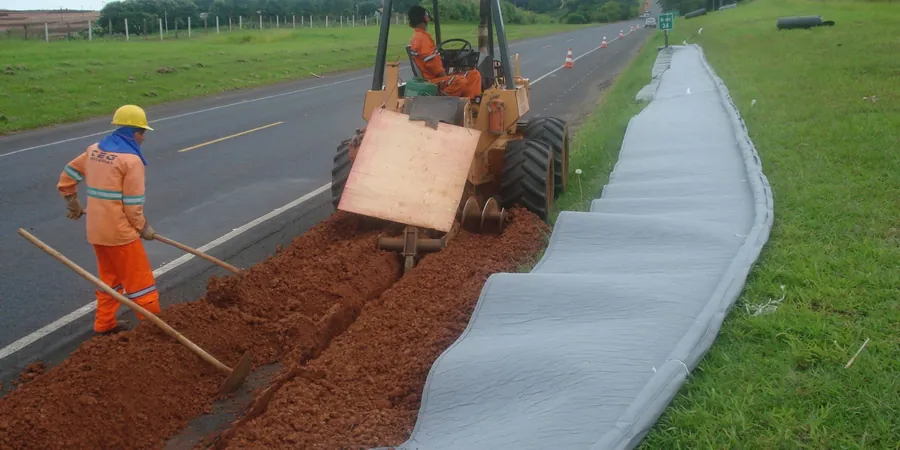
A single poorly placed subdrain in Anchorage’s silty subgrade can cause a road to fail within two freezing seasons.
Scope of work
Area-specific notes
A recent subdivision road along Raspberry Road was built without a perimeter drain on the upslope side. After three winters, water migrating from the adjacent hillside saturated the gravel base, causing differential heave and longitudinal cracking. The repair required full-depth reclamation and installation of a 200 mm subdrain with a geotextile wrap. In Anchorage, the biggest risk is assuming that well-draining surface gravel means the subgrade is dry. Silt layers just below the surface can hold water for weeks. A transient perched water table develops quickly during spring melt or fall rain, and without a properly designed geotechnical road drainage system, the pavement structure fails from below.
Standards used
ASTM D1883 (CBR for subgrade/base), ASTM D698 (Standard Proctor compaction), AASHTO M288 (Geotextile specification), IBC Chapter 18 (Foundation and subdrainage), ASCE 7 (Rain loads and frost depth)
Linked services
Subsurface Drainage Design
Layout of trench drains, interceptor drains, and collector pipes based on soil permeability, slope, and water table. We size the system using Darcy’s flow equation and verify with onsite infiltration tests.
Filter and Geotextile Selection
Specification of graded filter aggregates and nonwoven geotextiles to prevent piping and clogging. We follow AASHTO M288 and FHWA guidelines to match the filter to Anchorage’s silty and gravelly soils.
Construction Observation and Testing
On-site verification of drain alignment, backfill compaction, and geotextile overlap. We perform field permeability tests and density tests (ASTM D6938) to confirm design assumptions during installation.
Typical parameters
Q&A
Why is geotechnical road drainage especially important in Anchorage?
Anchorage's subarctic climate produces deep seasonal frost, high snowmelt volumes, and fine-grained silty soils that retain water. Without a properly designed drainage system, water trapped beneath the pavement freezes, forming ice lenses that heave and crack the road surface. Proper drainage extends pavement life by years.
How much does a geotechnical road drainage study cost in Anchorage?
For a typical residential or commercial road project, the cost ranges between US$770 and US$2,520 depending on project size, number of test pits, and laboratory testing required. This includes field investigation, permeability testing, and a detailed drainage design report.
What standards do you follow for drainage design in Anchorage?
We design in accordance with IBC Chapter 18, AASHTO M288 for geotextiles, and ASTM D1883 for subgrade strength evaluation. Frost depth is calculated per ASCE 7 using local climate data. All drain pipe and aggregate specifications follow ASTM C33 and AASHTO standards.
Do you recommend subdrains for all road projects in Anchorage?
Not always. On well-drained glacial till slopes with low water tables, surface crowning and roadside ditches may suffice. However, in areas with silty subgrades, seasonal high water tables, or cut sections below natural grade, subdrains are essential. We evaluate site-specific conditions to recommend the most cost-effective solution.