Anchorage sits on a complex mosaic of glacial till, outwash, and marine clays deposited during the Pleistocene, all overlaying a deep sedimentary basin that amplifies seismic waves. The 1964 Great Alaska Earthquake (M9.2) triggered widespread liquefaction in the Turnagain Arm and downtown areas, turning sandy silt layers into slurry and causing catastrophic lateral spreading. For any new development in this subarctic setting — from the Hillside subdivisions to the Port of Alaska — a thorough soil liquefaction analysis Anchorage is not optional; it is the single most important step to prevent foundation failure during the next design-level earthquake. The region's shallow groundwater table (often 2-4 meters below grade) combined with loose saturated sands creates a textbook scenario for pore pressure buildup. A proper evaluation integrates SPT blow counts, grain-size curves, and cyclic stress ratios to map zones of potential instability, ensuring that buildings, bridges, and pipelines are sited and founded on non-liquefiable strata or that mitigation measures are applied early in the design process.
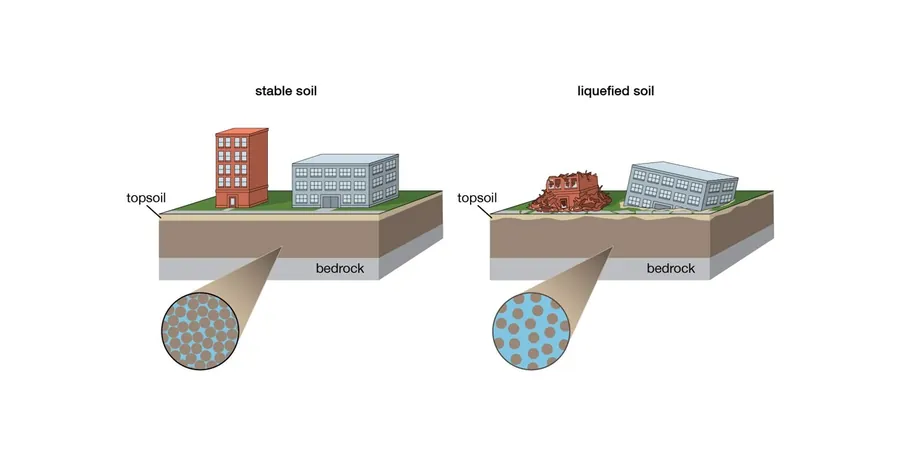
In Anchorage, the 1964 earthquake proved that loose saturated sands can turn to liquid in seconds — no building code can ignore that history.
Scope of work
Area-specific notes
The geology beneath Anchorage is dominated by the Bootlegger Cove Formation — a glaciomarine clay-silt unit that is both highly sensitive and prone to strength loss when disturbed. Below that, discontinuous layers of loose sand and gravel host pockets of artesian groundwater. During the 1964 quake, liquefaction of these sands caused the Turnagain Heights landslide, which destroyed 75 homes and displaced the ground horizontally by up to 600 meters. Today, any parcel within the Anchorage Bowl or the Ship Creek valley carries a moderate-to-high liquefaction hazard rating from the USGS. A soil liquefaction analysis Anchorage that only samples one borehole per acre risks missing a critical sand lens. We recommend a minimum of one SPT boring per 2,000 square meters in high-risk zones, with additional CPT soundings to interpolate between boreholes. The cost of missing a liquefiable layer far exceeds the investment in thorough testing — especially when lateral spread can shear piles and rupture utility lines within seconds.
Watch how it works
Standards used
NCEER (Youd & Idriss 2001) — SPT-based liquefaction triggering, ASCE 7-22 Section 11.4 — Site class and seismic design categories, ASTM D1586-18 — Standard Test Method for SPT, IBC 2021 Chapter 18 — Soils and foundations
Linked services
SPT-Based Liquefaction Assessment (NCEER Method)
Standard Penetration Tests at 1.5 m intervals in accordance with ASTM D1586, with energy correction (ERr) applied to achieve reliable (N₁)₆₀ values. Samples are classified on-site and tested for fines content in our Anchorage lab. The CRR is calculated per NCEER curves, and the Factor of Safety is plotted against depth for the design earthquake magnitude and peak ground acceleration. The final deliverable includes a Liquefaction Potential Index (LPI) map and recommendations for mitigation such as stone columns or deep foundations.
CPTu Liquefaction Screening (Robertson & Wride 1998)
Cone Penetration Testing with pore pressure measurement to obtain continuous profiles of soil behavior type, normalized cone resistance (Qtn), and friction ratio (Fr). The CPTu method is particularly effective in Anchorage's interbedded sand-silt sequences because it detects thin liquefiable layers that SPT might miss. We apply the Robertson & Wride (1998) methodology to compute CRR and FS. For marine clay sites near Knik Arm, we supplement with cyclic triaxial tests to refine the cyclic strength parameters.
Typical parameters
Q&A
How is soil liquefaction analysis performed in Anchorage's cold climate?
Fieldwork in Anchorage requires frost penetration management. We schedule SPT and CPTu drilling during the thaw season (May–October) or use heated shelters and insulated rods for winter work. All samples are kept above freezing during transport to prevent ice lens disturbance. The analysis itself is temperature-independent; it relies on corrected SPT blow counts, fines content, and cyclic stress ratios computed from the site-specific PGA assigned by the USGS seismic hazard model for south-central Alaska.
What buildings in Anchorage require mandatory liquefaction analysis?
The Anchorage Municipal Code requires a geotechnical report that includes liquefaction assessment for any new building in Seismic Design Category D or above, which covers most structures in the Anchorage Bowl. Specifically, Risk Category II buildings over three stories, all Risk Category III (schools, hospitals, emergency services), and any structure on a site with known liquefiable soils must provide a Site Class F determination. The analysis must follow ASCE 7-22 and reference the Municipality of Anchorage Geotechnical Hazard Maps.
Can structural fills or stone columns eliminate liquefaction risk in Anchorage?
Yes, but only if the mitigation is designed for the specific liquefiable layer thickness and depth. Stone columns (vibro-replacement) densify loose sands and provide drainage to dissipate pore pressure. In Anchorage, where the liquefiable layers are often 2–8 meters thick and overlain by stiff crust, stone columns installed to a diameter of 0.8–1.2 m on a triangular grid (typically 2–3 m spacing) can increase the Factor of Safety above 1.3. For sites underlain by the Bootlegger Cove clay, deep foundations such as driven piles or drilled shafts are preferred because the clay itself can lose strength. A post-mitigation CPTu or SPT program is always required to verify improvement.
How much does a soil liquefaction analysis cost in Anchorage?
A standard liquefaction assessment for a single-family lot (one SPT boring to 15 m depth, lab classification, and NCEER analysis) typically costs between US$2,520 and US$4,300. For larger commercial or multi-building sites requiring multiple borings and CPTu soundings, the cost scales proportionally, ranging from US$6,000 to US$18,000 depending on the number of soundings and the complexity of the stratigraphy. These estimates include field drilling, laboratory testing, and a sealed geotechnical report. Expedited or winter-access projects may incur additional mobilization fees.