Anchorage sits at 61°N, just 60 miles from the epicenter of the 1964 Good Friday earthquake—a magnitude 9.2 event that liquefied the Turnagain Arm and collapsed dozens of structures. That history makes shear wave velocity data non-negotiable here. MASW surveys map Vs30 profiles through the glacial till, alluvial fans, and Bootlegger Cove clay that underlie most of the city, giving structural engineers the site class they need under ASCE 7. Without a reliable Vs30 value, the seismic design spectrum is a guess. We combine surface-wave inversion with local borehole control to produce profiles that match the Municipality of Anchorage geotechnical requirements. For projects on the Hillside or along the Ship Creek corridor, we often cross-check MASW results with a cone penetration test to validate stiffness layering, and when liquefaction susceptibility is a concern, we integrate results with a dedicated liquefaction analysis to refine the cyclic resistance ratio.
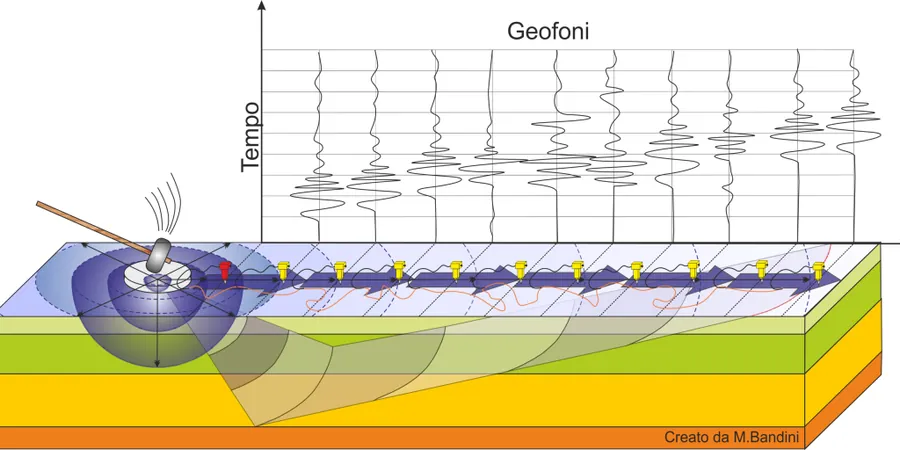
A single MASW line can identify a 20% drop in shear-wave velocity across a property boundary—critical for site class assignment under ASCE 7.
Scope of work
Area-specific notes
The freeze-thaw cycle in Anchorage creates a seasonal active layer that can alter near-surface velocities by up to 15% between March and August. If you run MASW in late winter when the ground is frozen, you might overestimate the Vs30 and assign a stiffer site class than what exists during summer thaw. We schedule surveys during the thawed window—typically mid-May through September—and record soil temperature at 0.5 m depth to confirm the active layer is fully melted. In areas underlain by ice-rich silt (common along the Glenn Highway corridor), we also run a ground-penetrating radar line parallel to the MASW transect to detect ice lenses that could skew the velocity inversion. Overlooking seasonal effects is the fastest way to get a site class wrong in Anchorage, and that mistake ripples into the entire seismic design.
Standards used
ASTM D4428/D4428M-14 (Standard Test Methods for Crosshole Seismic Testing), ASCE 7-22 Section 20.3 (Site Class Determination Using Vs30), NEHRP Recommended Seismic Provisions (FEMA P-1050, Site Class Definitions), IBC 2021 Chapter 16 (Seismic Design Categories Based on Site Class)
Linked services
Standard Vs30 Profile (Single Line)
One 300 m transect, 24-channel landstreamer, sledgehammer source. Delivered as a Vs30 profile, dispersion curves, inverted 1D shear-wave velocity model, and ASCE 7 site class assignment. Suitable for most commercial and residential parcels where the geology is relatively uniform.
Multi-Line Site Characterization
Two to four parallel and cross lines covering up to 1,200 m total. Produces a pseudo-2D Vs cross-section and identifies lateral variability across a property. Recommended for large subdivisions, school sites, or hospital expansions in Anchorage where the soil profile changes across the lot.
Integrated MASW + Refraction Tomography
Combined surface-wave and P-wave refraction acquisition on the same spread. Yields both Vs and Vp profiles, Poisson's ratio, and depth to bedrock or dense till. Often specified by structural engineers for buildings over six stories or critical infrastructure like the Port of Alaska.
Typical parameters
Q&A
What is the difference between Vs30 from MASW and Vs30 from a borehole test?
MASW measures the average shear-wave velocity of the upper 30 m using surface waves propagating through the entire soil column, giving a spatially averaged profile. A borehole test, like crosshole or downhole, samples a single point. MASW captures lateral variability and avoids the cost of multiple deep borings, but it relies on inversion assumptions. For projects with high seismic risk, we often run both to cross-validate.
How much does a MASW / Vs30 survey cost in Anchorage?
A standard single-line MASW survey in Anchorage typically ranges between US$1,910 and US$3,390, depending on line length, site access, and the need for integrated refraction tomography. Multi-line campaigns or projects requiring winter ice mitigation may fall at the upper end. We provide a fixed-cost quote after a brief site review.
Can MASW be used for liquefaction triggering analysis?
Yes, but indirectly. MASW provides the small-strain shear modulus (Gmax = ρ × Vs²), which is a key input for the cyclic stress ratio and modulus reduction curves in liquefaction triggering models (Youd et al., 2001). However, liquefaction analysis also requires grain-size distribution, fines content, and CPT or SPT resistance. We recommend combining MASW with a CPT and lab index tests for a complete liquefaction assessment.