Anchorage sits on a deep alluvial basin where glacial till, silty sands, and layered clays dominate the upper 30 meters. Many times we see projects assume a simple spread footing will work, only to find differential settlements of 5 to 8 cm after one winter freeze-thaw cycle. That is why raft/mat foundation design in Anchorage requires a careful balance between bearing capacity and frost protection. We start by correlating SPT blow counts with plate load test results to calibrate the modulus of subgrade reaction. Before laying out the mat, we also run a consolidation test on undisturbed samples to quantify long-term settlement under the full structural load. The goal is a stiff mat that distributes column loads across a wide footprint while resisting the uplift pressures that develop in silty soils during spring thaw. Our designs follow IBC 2021 Chapter 18 and ASCE 7-22 seismic provisions, adjusted for Site Class D or E depending on the Vs30 profile measured on site.
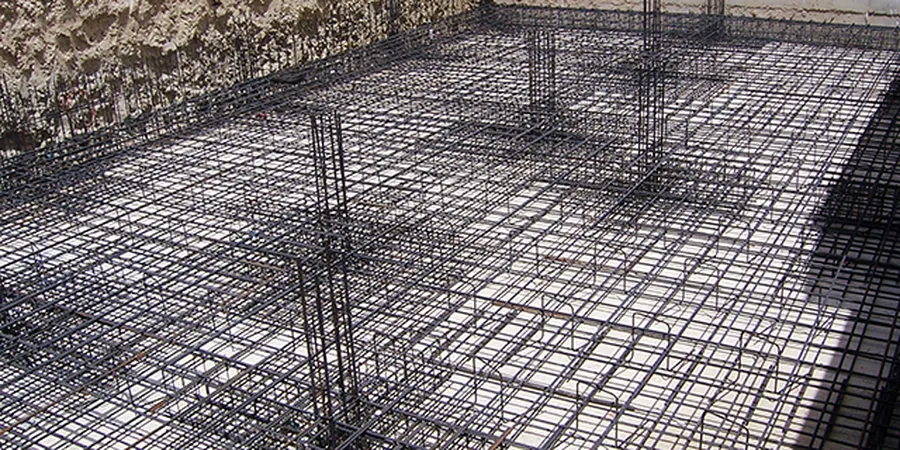
A properly designed raft in Anchorage must resist both 0.6 g seismic accelerations and 2.5 m of seasonal frost penetration — two extremes rarely combined elsewhere.
Scope of work
Area-specific notes
The most common mistake we see in Anchorage is contractors pouring a uniform-thickness mat without verifying the subgrade uniformity. A 50 cm thick slab over a buried organic pocket will crack in the first winter. Another frequent error is neglecting the net uplift from frost jacking on the mat edges. We have repaired three parking garages in Midtown where the raft lifted 4 cm at the perimeter, cracking the slab-on-grade above. Our design review always includes a check for the frost heave force per unit area (typically 100–150 kPa) and requires a drainage layer beneath the mat to prevent water accumulation. Combining the raft with a preload surcharge on soft zones before casting the mat can reduce post-construction settlement by 60%.
Standards used
IBC 2021 Chapter 18 — Soils and Foundations, ASCE 7-22 — Minimum Design Loads (Seismic & Snow), ASTM D1586-18 — Standard Test Method for SPT, ASTM D2487-17 — Unified Soil Classification System
Linked services
Site-Specific Bearing Capacity Analysis
We perform plate load tests (ASTM D1194) and SPT correlations to determine the in-situ bearing capacity and modulus of subgrade reaction. Results are calibrated to the local glacial till and alluvial sand layers typical of the Anchorage bowl.
Frost Heave & Differential Settlement Modeling
Using site-specific soil suction curves and freeze-thaw cycle data from the National Weather Service, we model the seasonal heave potential. The output sets the required mat thickness and reinforcement to keep differential movement below 2 cm.
Seismic Mat Response Analysis
We run nonlinear dynamic analyses (equivalent linear or fully nonlinear) using recorded Anchorage ground motions from the USGS database. The analysis checks sliding, bearing capacity, and overturning under the MCE level event.
Typical parameters
Q&A
What is the typical cost for a raft foundation design study in Anchorage?
A full raft design study—including site investigation, bearing capacity analysis, frost heave modeling, and seismic response—ranges between US$900 and US$3,880. The final price depends on the number of borings required and whether advanced laboratory tests (triaxial, consolidation) are needed.
Can a raft foundation handle the seismic demands of Anchorage's Design Category D?
Yes, when properly designed. The mat must be stiff enough to resist rocking and sliding. We verify that the base shear does not exceed the soil-mat interface friction capacity, and we add shear keys or embedment if needed. The key is to match the mat stiffness to the site period to avoid resonance.
Is a raft foundation suitable for sites with deep frost penetration (up to 2.5 m)?
A conventional raft placed directly on frost-susceptible soil will heave. We mitigate this by specifying a granular capillary break layer (300–500 mm of clean gravel) below the mat, combined with perimeter insulation (extruded polystyrene, 50–100 mm thick). In extreme cases, we use a ventilated crawl space beneath the raft.