Anchorage grew fast after the 1964 Good Friday earthquake, when rebuilding pushed construction onto steeper hillsides and soft glacial deposits. That history left us with a landscape where slope failure analysis is not optional — it is a requirement for any project on the Hillside or along Turnagain Arm. Our team has been working these soils since the mid-2010s, and we have seen how quick thaw cycles and high groundwater can turn a stable cut into a liability. Before we even model a slip surface, we always run a compression simple test on undisturbed samples to get baseline strength. That data feeds directly into our limit-equilibrium models.
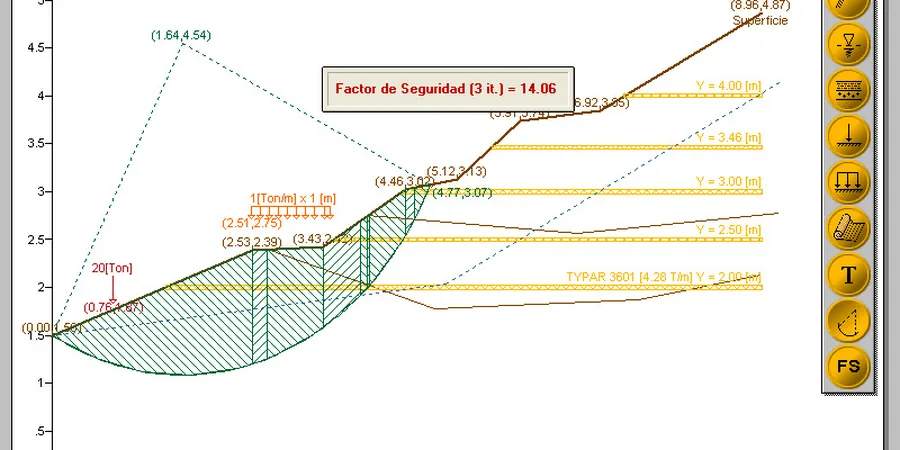
In Anchorage, the most overlooked trigger for slope failure is not an earthquake — it is rapid snowmelt saturating the Bootlegger Cove clay.
Scope of work
Area-specific notes
What catches many developers off guard in Anchorage is the combination of high seismicity and sensitive clays. A moderate earthquake can trigger liquefaction in the sandy lenses within the Bootlegger Cove Formation, which then causes the overlying clay to lose strength and flow. We have mapped several ancient landslide complexes near Huffman Road and the South Fork of Campbell Creek that reactivate every few decades. The real risk is not just the first-time slide — it is the progressive failure that follows, where each winter's freeze-thaw cycle opens new cracks that fill with water come spring. Ignoring that cycle has led to million-dollar repairs on residential subdivisions.
Standards used
ASCE 7-22 Minimum Design Loads and Associated Criteria, FHWA-NHI-05-089 Slope Stability Reference Manual, ASTM D4767-11 Standard Test Method for Consolidated Undrained Triaxial Compression Test
Linked services
Limit-Equilibrium Modeling (LEM)
We use Spencer and Bishop methods in Slide 6.0 to analyze circular and non-circular slip surfaces. All models incorporate pore-water pressure measured from standpipes installed during the wet season.
Seismic Slope Stability Assessment
Pseudostatic and Newmark displacement analyses using site-specific PGA values from the USGS seismic hazard model for Anchorage. We also evaluate cyclic softening in sensitive clays.
Remediation Design and Monitoring
From subsurface drainage to soil nailing and buttress fills, we design solutions that match the local soil conditions. We also install inclinometers and piezometers to verify long-term performance.
Typical parameters
Q&A
What is the difference between slope failure analysis and a standard geotechnical report?
A standard geotechnical report covers bearing capacity, settlement, and general soil conditions. Slope failure analysis focuses specifically on the stability of a cut or fill slope, including groundwater effects, seismic loading, and potential failure mechanisms. It uses limit-equilibrium or finite-element modeling to calculate factor of safety.
How much does a slope failure analysis cost in Anchorage?
For a typical residential lot or small commercial site, the cost ranges from US$900 to US$2,220. This includes field investigation, laboratory testing, modeling, and a written report with recommendations. Larger slopes or sites requiring deep borings may fall outside that range.
How deep do you need to drill for a slope stability study?
We drill borings to at least 1.5 times the height of the slope, or until we encounter a competent bearing layer below the potential failure surface. In the Bootlegger Cove Formation, that often means depths of 10 to 20 meters. We also install groundwater monitoring wells to capture seasonal fluctuations.
Can you analyze a slope that already has cracks or movement?
Yes — we call that a distressed slope assessment. We survey the cracks, install surface markers to measure movement rates, and take undisturbed samples from the shear zone. The analysis then considers the residual strength of the soil, not just peak strength, because the failure surface has already partially developed.