We start with a truck-mounted drill rig that pushes thin-wall Shelby tubes into Anchorage's glacial-lacustrine clay layers, which can swell up to 8% when wetted. The operator keeps a close eye on torque and fluid returns because permafrost lenses and ice-rich silt can fake you out during sampling. In the lab, we measure free-swell index and swelling pressure on undisturbed specimens, then run a double-oedometer test to separate heave from collapse. Before we even mobilize, we cross-check the site with NRCS soil surveys and the Anchorage Soil Map, which often flags the Bootlegger Cove Formation as highly expansive near Ship Creek. That data feeds directly into foundation recommendations, and we usually pair it with a consolidation test to estimate post-construction settlement under load.
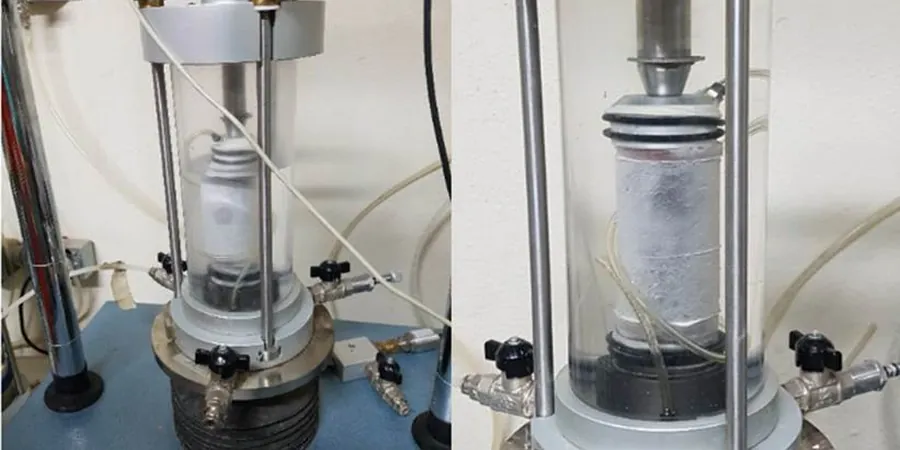
Anchorage's Bootlegger Cove clay can generate swelling pressures exceeding 8,000 psf, enough to crack a 6-inch slab if not mitigated with proper overexcavation and moisture control.
Scope of work
- Plasticity index and clay mineralogy via X-ray diffraction (smectite content drives heave potential)
- Swell-consolidation curves under surcharge loads from 0.25 to 4.0 ksf
- Frost-susceptibility classification per USACE CRREL criteria
- Soil suction measurements using filter-paper method (ASTM D5298)
Area-specific notes
The difference between a foundation on Eagle River gravel versus one on Bootlegger Cove clay in downtown Anchorage is night and day. In the Turnagain neighborhood, where the Bootlegger Formation is thick, we've documented slab heave of 4 to 6 inches over five years in houses without proper moisture barriers. That kind of movement cracks drywall, shifts door frames, and can snap utility lines. The real kicker is that the clay swells unevenly — the south-facing side of a building dries out faster in summer, creating differential heave that twists the structure. On the Hillside, where colluvial soils overlie bedrock, the risk is lower but frost jacking can mimic expansive soil behavior. We always run a soil suction test to confirm the actual driving mechanism before designing a remediation plan.
Standards used
ASTM D4318-17 (Atterberg Limits), ASTM D4546-14 (One-Dimensional Swell/Collapse), ASTM D5298-16 (Soil Suction – Filter Paper), USACE CRREL TR-00-8 (Frost Susceptibility)
Linked services
On-Site Swell Testing
In-situ swell pressure measurement using borehole dilatometer and suction lysimeters to capture natural moisture regime.
Laboratory Swell-Consolidation
Double-oedometer and cyclic swell-shrink tests on undisturbed Shelby tube samples to predict heave under seasonal moisture changes.
Clay Mineralogy Analysis
X-ray diffraction (XRD) and cation exchange capacity (CEC) to identify smectite, illite, and kaolinite content driving expansion potential.
Frost-Heave Interaction Study
Combined freeze-thaw and swell testing to evaluate how ice lens formation alters expansive behavior in Anchorage's subarctic climate.
Typical parameters
Q&A
How much does an expansive soil evaluation cost in Anchorage?
For a typical single-family lot (3 boreholes to 15 ft depth), the evaluation ranges from US$580 to US$1,560, including Atterberg limits, free swell, and swelling pressure tests. Larger commercial sites with multiple boreholes and mineralogy analysis can go higher.
What is the difference between swelling pressure and free swell index?
Swelling pressure is the vertical stress required to prevent the soil from expanding when wetted, measured in psf or kPa. Free swell index is the percent volume increase of a dry clay pellet placed in water. For Anchorage clays, a free swell above 5% usually correlates with swelling pressures over 4,000 psf.
Which neighborhoods in Anchorage have the most expansive soils?
The Bootlegger Cove Formation dominates central Anchorage — Turnagain, Spenard, and parts of Midtown. The Hillside and Eagle River areas have less expansion potential due to coarser glacial till and bedrock. We always check the USDA soil survey and historical heave records before quoting.
Can expansive soil be mitigated without removing it all?
Yes. Overexcavation of the top 3-4 ft and replacement with non-expansive select fill (sand or crushed gravel) is common. So is moisture conditioning with lime or cement, combined with a capillary break layer and proper drainage. For existing slabs, post-tensioned foundations or helical piers can bypass the swell zone.