A common mistake contractors make on Anchorage projects is assuming that removing organic topsoil and placing select granular fill alone solves the bearing problem. They overlook the deep silty clay layers that cover much of the city, from Turnagain to Eagle River. These fine-grained soils, often saturated from shallow groundwater tables at 2 to 4 feet, lose strength during spring thaw and become nearly impossible to compact properly. Lime and cement stabilization addresses the plasticity and moisture sensitivity directly, converting the clay into a workable, cementitious base before any structural fill goes down. We have seen parking lots and light industrial slabs crack within two years simply because the subgrade was never chemically treated.
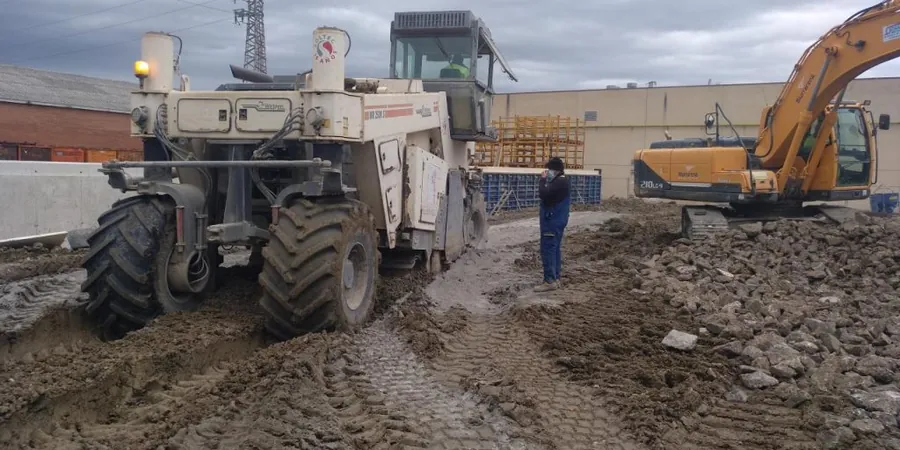
Treating the Bootlegger Cove clay with 5% lime can reduce its plasticity index from 35 to below 10 within 72 hours of mellowing.
Scope of work
Area-specific notes
In Anchorage, we frequently see stabilization failures caused by inadequate mixing depth. Contractors try to blend lime into the top 6 inches with a motor grader, but the clay lenses extend deeper than that. The untreated clay below the stabilized crust remains frost-susceptible and can heave differentially during the winter, breaking the treated slab above. Another local risk is the presence of ice lenses within the soil profile; if the stabilization is performed in early spring before the ground fully thaws, the chemical reaction cannot reach the frozen pockets, leaving soft spots that fail under load. We always recommend a pre-treatment thaw depth verification using a hand auger to confirm the active layer depth.
Standards used
ASTM D6276 (Standard Test Method for Using pH to Estimate the Soil-Lime Proportion Requirement), ASTM D4609 (Guide for Evaluating Effectiveness of Admixtures for Soil Stabilization), IBC Chapter 18 (Soils and Foundations), AASHTO T-220 (Determining the Strength of Soil-Lime Mixtures)
Linked services
Lime Stabilization Design
We determine the optimum lime content through Eades & Grim pH tests (ASTM D6276) and verify strength gain with unconfined compression tests on 28-day cured specimens. We also run Atterberg limits before and after treatment to confirm PI reduction.
Cement Stabilization Design
For projects requiring faster strength gain, we design cement blends using Type I/II Portland cement. We perform moisture-density relations (ASTM D558) and wet-dry durability tests to ensure the mix can withstand Anchorage's freeze-thaw cycles.
Field Quality Control for Stabilization
Our technicians verify mixing depth, uniformity of application, and in-place density using nuclear gauges (ASTM D6938). We collect undisturbed samples for laboratory verification of compressive strength and document compliance with project specifications.
Typical parameters
Q&A
How much does lime and cement stabilization cost in Anchorage?
The typical cost for lime and cement stabilization in Anchorage ranges between US$840 and US$2,420 per project, depending on the treatment depth, the additive quantity, and the number of laboratory tests required. This includes mix design, field quality control, and a final compressive strength report.
What is the difference between lime stabilization and cement stabilization for Anchorage soils?
Lime stabilization works by modifying the clay's plasticity through cation exchange, reducing its affinity for water and making it less frost-susceptible. Cement stabilization adds strength through hydration and is better for soils that already have low plasticity but need improved bearing capacity. For Anchorage's high-plasticity clays, lime is usually preferred, but a cement cap may be used for the top 4 inches to provide a firm working platform.
Can stabilization be performed during winter in Anchorage?
Stabilization is not recommended when the ground temperature is below 40°F because the chemical reactions slow down significantly. If winter work is unavoidable, we can design a mix with accelerated curing additives, but the treated area must be insulated with geotextile blankets or straw for at least 7 days to maintain adequate curing temperatures.