The rigs used for preloading with surcharge design in Anchorage often feature tracked carriers to handle the soft, saturated tundra. On a typical site near Ship Creek, a crew unloads a vibrating roller and a fleet of dump trucks. Before any fill is placed, the team installs settlement plates and piezometers. The goal is to accelerate primary consolidation under controlled load. Anchorage ground conditions demand this staged approach. The preloading with surcharge design must account for thaw-unstable permafrost and the thick Bootlegger Cove Formation clay. Without it, differential settlements can crack rigid structures. We pair this analysis with a geotechnical instrumentation plan to track pore pressure dissipation in real time.
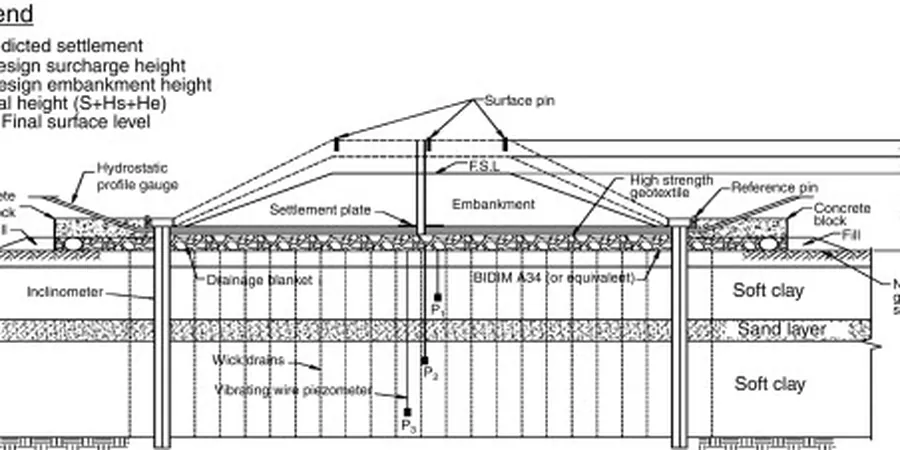
Preloading with surcharge design in Anchorage must account for thaw-unstable permafrost and the thick Bootlegger Cove Formation clay.
Scope of work
Area-specific notes
The Bootlegger Cove Formation at depths of 10 to 30 meters is a high-plasticity clay (CH) with undrained shear strengths as low as 20 kPa. This layer is notorious for causing delayed settlements and stability failures. A preloading with surcharge design in Anchorage that ignores the rate of strength gain risks a slope failure during fill placement. The 1964 Good Friday earthquake triggered widespread landslides in this same formation. Today, our preloading with surcharge design incorporates staged loading with pore pressure dissipation checks to maintain a factor of safety above 1.4 during construction. The seismic risk also requires evaluating cyclic softening of the clay under surcharge load.
Standards used
ASCE 7-22 (Minimum Design Loads and Criteria), IBC 2021 (Chapter 18: Soils and Foundations), ASTM D2435 (One-Dimensional Consolidation Properties of Soils), FHWA NHI-06-088 (Improvement Methods)
Linked services
Preloading Design & Analysis
Full consolidation analysis using oedometer test data from Bootlegger Cove clay. We determine surcharge height, staged loading schedule, and monitoring criteria per ASTM D2435. Output includes time-settlement curves and factor of safety checks.
Instrumentation & Monitoring
Installation of settlement plates, vibrating wire piezometers, and inclinometers. Real-time data logging with automated alerts if pore pressure exceeds design threshold. Weekly progress reports for Anchorage projects.
Quality Control Testing
Field density tests (ASTM D6938) and laboratory consolidation tests on undisturbed samples. Verification that achieved pre-compression matches design target. Documentation for IBC compliance.
Typical parameters
Q&A
How does preloading with surcharge differ from simple preloading?
Simple preloading applies a load equal to the final structure load to reduce future settlement. Preloading with surcharge applies a temporary load greater than the final load. This overconsolidates the soil, so post-construction settlements are minimized. In Anchorage, surcharge is often 1.2 to 1.5 times the design load to offset creep in the clay layers.
What is the typical duration of surcharge in Anchorage?
For soft clay deposits common in midtown and south Anchorage, surcharge periods range from 3 to 6 months. In areas with thicker Bootlegger Cove clay (over 15 m), it may extend to 12 months. The exact duration is determined by the rate of pore pressure dissipation measured by piezometers.
Can preloading with surcharge be used on permafrost?
Yes, but only after a thaw-stability analysis. In Anchorage, where permafrost is discontinuous and often degrading, the surcharge load must be applied during summer when the active layer is thawed. The design must account for potential thaw settlement of underlying ice-rich soils. We always recommend a thermal analysis alongside the consolidation design.
What is the cost range for a preloading with surcharge design in Anchorage?
The cost for a complete preloading with surcharge design, including field instrumentation and laboratory testing, typically ranges between US$920 and US$2,890. Final pricing depends on site area, number of settlement plates, and depth of clay. For a typical 5,000 sq ft tank pad, expect the lower end of the range.