For construction projects across Anchorage, verifying compaction levels is critical — especially given the city's extensive areas of frost-susceptible silty soils and permafrost-affected ground. The field density test (sand cone method) performed in accordance with ASTM D1556 provides a direct, in-situ measurement of soil density and relative compaction. This method is particularly relevant in Anchorage because the seasonal freeze-thaw cycle can significantly alter soil structure, making reliable compaction verification essential for pavement and foundation performance. Before placing structural fill, a geotechnical investigation typically identifies the soil type and moisture conditions, while the sand cone test confirms that the achieved density meets project specifications. The procedure involves excavating a small test hole, filling it with calibrated sand, and weighing the extracted material to calculate dry density.
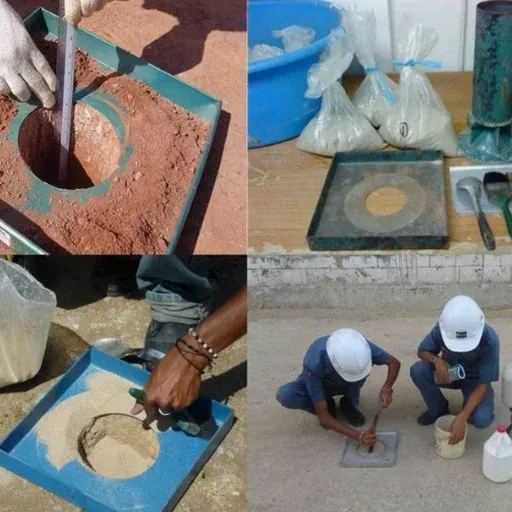
One sand cone test in Anchorage's silty soils can catch a compaction deficiency that might otherwise lead to differential settlement within the first freeze-thaw cycle.
Scope of work
Area-specific notes
The sand cone test crew sets up near an active fill zone in Anchorage — a 4WD pickup carries the sand and tools, and the technician marks a 6-inch ring on the compacted surface. After digging the hole with a hand auger and chisel, all excavated soil goes into a sealed bag. The sand cone apparatus is then placed over the hole, and calibrated sand flows until the hole is full. One common challenge in Anchorage is the presence of oversized gravel or frozen clods that prevent a clean hole shape. In such cases, the test may need relocation or a larger hole diameter to get representative results. Skipping this verification on a utility trench backfill can lead to settlement under pavement within two winters — a costly repair that the field density test method is designed to prevent.
Standards used
ASTM D1556-16 (Standard Test Method for Density of In-Place Soils by Sand Cone), ASTM D698-12 (Standard Proctor Compaction Test), AASHTO T 191 (Density of Soil In-Place by the Sand-Cone Method)
Linked services
Standard Sand Cone Density Test
In-situ density measurement per ASTM D1556 for fine- to medium-grained soils, including moisture content determination.
Nuclear Gauge Correlation
Calibration of nuclear density gauges against sand cone results for large-volume projects requiring rapid testing.
Lift-by-Lift Compaction Monitoring
Sequential density checks on each soil lift (6-12 inches) during fill placement for retaining walls, road bases, and building pads.
Frost-Susceptibility Evaluation
Extended sand cone testing combined with grain-size analysis to assess heave potential in Anchorage's silty subgrades.
This service complements our laboratory testing work for a complete project analysis.
Typical parameters
Q&A
What is the difference between the sand cone test and a nuclear gauge?
The sand cone test is a direct, gravimetric method that measures actual soil density by excavating a hole and weighing the material. A nuclear gauge uses radiation backscatter and is faster, but requires calibration against sand cone results for accuracy, especially in Anchorage's silty soils.
How much does a field density test (sand cone method) cost in Anchorage?
The typical cost for a single sand cone test in Anchorage ranges from US$90 to US$130 per test point, including moisture determination. Volume discounts apply for projects requiring multiple tests across different lifts or locations.
Can the sand cone test be used on frozen ground in Anchorage?
No, the sand cone method is not reliable on frozen soil because the ice alters the excavation geometry and moisture content. In winter conditions, alternative methods like nuclear gauge or time-domain reflectometry are recommended for compaction verification.
How many sand cone tests are needed for a typical Anchorage building pad?
For a residential building pad of about 2,000 square feet, we recommend at least one sand cone test per 500 square feet of compacted area, plus one test per lift for each soil type. Commercial projects follow a frequency per ASTM D1556 guidelines based on volume placed.