Anchorage sits on deep deposits of Bootlegger Cove clay, a formation known for high plasticity and low undrained shear strength. These soils, reaching over 100 meters in thickness in some areas, make preloading design without surcharge a critical step for any significant fill or embankment project. The method relies on gradual load application to achieve primary consolidation before construction, reducing post-construction settlements. In a subarctic climate with freeze-thaw cycles, timing the preloading sequence around the short summer window adds complexity. Engineers here typically target 90% or more primary consolidation within a single construction season, using field instrumentation like settlement plates and piezometers to verify progress. A well-executed preloading design without surcharge can cut long-term differential settlements by half compared to untreated ground. The approach is especially relevant for highway approaches, storage yards, and light industrial slabs where absolute settlement tolerances are tight.
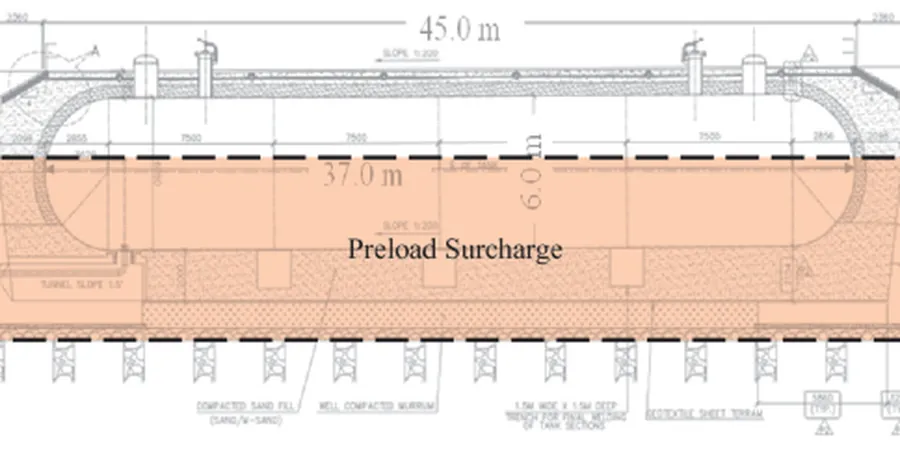
Without surcharge, every inch of settlement prediction depends on accurate lab consolidation data from undisturbed samples.
Scope of work
- Field sampling with thin-walled Shelby tubes to minimize disturbance
- One-dimensional consolidation testing per ASTM D2435 to determine cv and Cc
- Numerical modeling using finite element software to predict settlement rates
- Integration of vertical drains to accelerate drainage when time is limited
- Installation of settlement markers and piezometers for real-time monitoring
Area-specific notes
The most common mistake contractors make in Anchorage is underestimating the time required for consolidation without surcharge. They often assume that soft clays will drain in weeks, but the low permeability of Bootlegger Cove clay can stretch the process to months. Without proper monitoring, they place fill too fast, triggering undrained failure or excessive pore pressures that damage adjacent utilities. Another frequent error is relying on index properties alone instead of site-specific consolidation tests. A generic correlation from Turnagain soils may not apply a few miles north. Skipping field verification of settlement rates leads to slabs that crack or differential heave that compromises structural integrity. Preloading design without surcharge demands patience and accurate lab data, not shortcuts.
Standards used
ASTM D2435 (Standard Test Methods for One-Dimensional Consolidation Properties of Soils), ASCE 7 (Minimum Design Loads and Associated Criteria for Buildings), IBC Chapter 18 (Soils and Foundations), FHWA NHI-06-088 (Manual on Subsurface Investigations)
Linked services
Consolidation Testing
Laboratory oedometer tests following ASTM D2435 to determine cv, Cc, and Cr for your specific soil profile.
Settlement Monitoring
Field installation of settlement plates, inclinometers, and piezometers with real-time data logging during preloading.
Numerical Modeling
Finite element analysis using Plaxis or similar software to predict consolidation rates and optimize fill placement schedules.
Geotechnical Site Investigation
Borehole drilling, undisturbed sampling, and In-Situ to characterize the stratigraphy and strength parameters.
Typical parameters
Q&A
What is the difference between preloading with and without surcharge?
Preloading without surcharge uses a fill height equal to the final design load, so the applied stress matches the permanent load. With surcharge, the fill is higher to accelerate consolidation, then removed after primary settlement. Without surcharge, the process takes longer but avoids the cost and logistics of importing and removing extra fill.
How long does preloading without surcharge take in Anchorage's clay?
In typical Bootlegger Cove clay with a cv of 4 m²/year and a 5-meter drainage path, reaching 90% consolidation can take 4 to 7 months. The exact duration depends on layer thickness, drainage conditions, and whether vertical drains are used.
What field monitoring is required for preloading without surcharge?
You need settlement plates to track vertical deformation, piezometers to measure pore pressure dissipation, and inclinometers if lateral movement is a concern. Data should be read weekly during active loading and biweekly during the consolidation period.
How much does preloading design without surcharge cost in Anchorage?
The cost for design, testing, and monitoring typically ranges between US$740 and US$2,280, depending on site complexity, number of boreholes, and duration of field monitoring. This includes lab consolidation tests, numerical modeling, and instrumentation installation.