Anchorage sits atop the Cook Inlet basin, a deep sedimentary trough overlain by glacial deposits and discontinuous permafrost. The team typically mobilizes a tracked drill rig to reach depths of 30 to 50 meters, extracting core samples through frozen silt and gravel layers. These samples are logged on site for soil classification and moisture content before being sealed for transport to the laboratory. The challenge in Anchorage is not just the cold but the rapid thaw that can turn a stable gravel into a slurry within hours. That is why each borehole is backfilled with a thermally stable grout to prevent future settlement. Before the rig arrives, we often run a microtremor HVSR survey to map the depth to bedrock and identify potential resonance frequencies of the soil column.
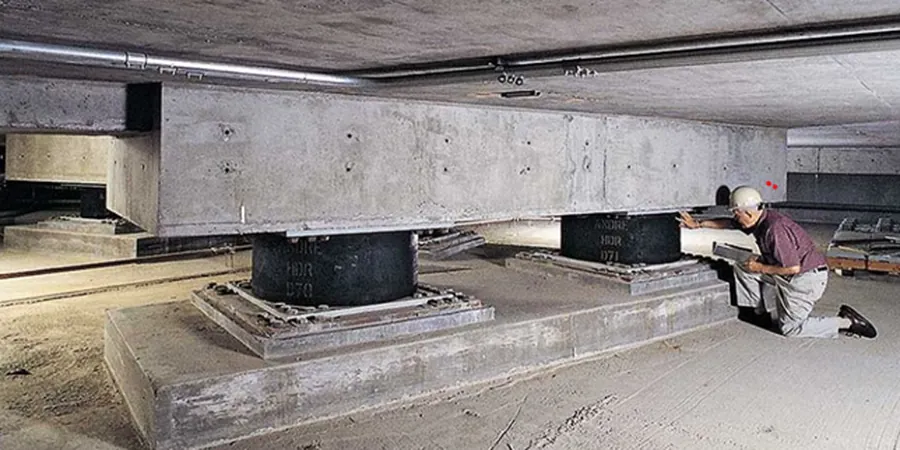
In Anchorage, the 1964 earthquake showed that liquefaction of sand lenses beneath glacial till can trigger differential settlements of over a meter.
Scope of work
Area-specific notes
ASCE 7-22 classifies most of Anchorage as Seismic Design Category D or E. The 1964 Good Friday earthquake (Mw 9.2) caused widespread liquefaction in the Turnagain Arm area, destroying over 200 homes. The risk is not just from the main shock. Aftershocks can trigger progressive failure in already weakened slopes, especially in the Hillside neighborhoods underlain by the Bootlegger Cove Formation. Our team evaluates both cyclic softening of cohesive soils and the potential for lateral spreading along the bluffs. We use the Youd-Idriss method (NCEER 2001) for liquefaction triggering analysis and cross-check with CPT-based methods when available.
Standards used
ASCE 7-22 (Minimum Design Loads and Associated Criteria for Buildings and Other Structures), IBC 2021 (International Building Code, Chapter 18 – Soils and Foundations), ASTM D1586-18 (Standard Test Method for Standard Penetration Test (SPT) and Split-Barrel Sampling of Soils), NEHRP Recommended Seismic Provisions (FEMA P-1050)
Linked services
Site-Specific Response Spectrum Analysis
Develop a design response spectrum based on measured shear-wave velocity profiles (Vs30) and site class. Includes probabilistic seismic hazard analysis (PSHA) for return periods of 475 and 2475 years.
Liquefaction Hazard Assessment
Evaluate liquefaction potential using SPT blow counts and CPT tip resistance. Output includes LPI maps, factor of safety against liquefaction, and estimated post-liquefaction settlement.
Permafrost-Sensitive Foundation Design
Design deep foundations (driven piles, helical piers) or insulated shallow foundations to maintain frozen ground conditions. Incorporates active-layer freeze-thaw cycling and thermal modeling.
Typical parameters
Q&A
What is the typical cost range for a seismic foundation design study in Anchorage?
For a single-family residence on a standard lot, expect between US$1,220 and US$4,110. The final cost depends on the number of borings, required lab tests, and whether a full site-specific response spectrum is needed. Larger commercial projects with multiple building pads can range higher.
How does permafrost affect seismic foundation design in Anchorage?
Permafrost acts as a stiff layer that can amplify high-frequency ground motions. During thaw, the same layer loses strength and may consolidate under cyclic loading. Design must include thermal stability measures such as thermosyphons or insulated foundations to prevent thaw settlement during an earthquake.
Which seismic design category applies to most sites in Anchorage?
The majority of Anchorage falls under Seismic Design Category D or E per ASCE 7-22. Category D applies to stiff soil sites (Site Class D), while Category E applies to soft soil sites (Site Class E) commonly found in the tidal flat areas near Ship Creek and the coastal bluffs.
Can you use SPT data alone for liquefaction analysis in Anchorage?
Yes, SPT-based methods (Youd-Idriss, 2001) are standard for liquefaction triggering. However, CPT provides continuous profiles and is preferred in stratified deposits like the Bootlegger Cove Formation. We often combine both methods to reduce uncertainty in layered soils with intermixed sand and silt lenses.