The Ménard pressuremeter test (PMT) in Anchorage typically deploys a 60 mm diameter probe lowered into a pre-drilled borehole, inflated by compressed nitrogen while a downhole transducer records volume change at 30-second increments. This setup requires a tracked drill rig capable of handling the city's glacial tills and discontinuous permafrost lenses — the rig itself must weigh at least 12 tons to maintain stability on Cook Inlet's silty clays. The test follows ASTM D4719-20, and the probe calibration is verified weekly against a certified reference cell. Complementing PMT data with a seismic cone penetration test can help differentiate between stress history and cementation effects in overconsolidated deposits, while a geotechnical borehole camera survey provides visual confirmation of fissures or ice lenses before inflation.
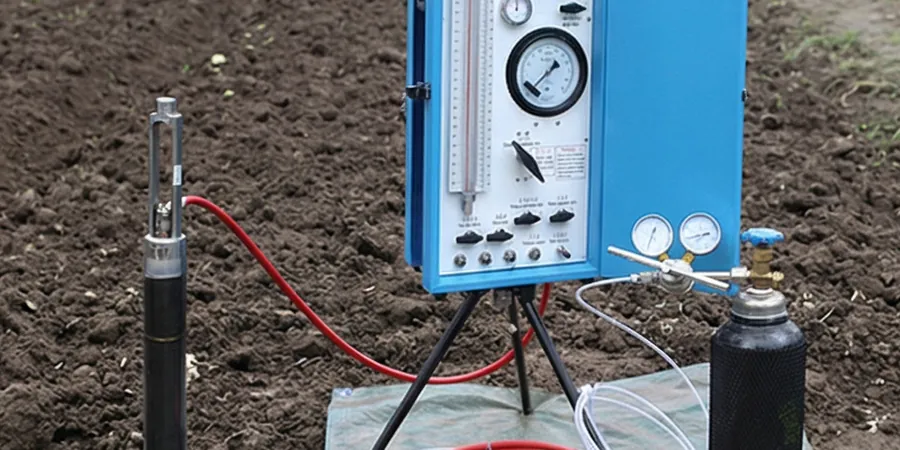
The Ménard pressuremeter is the only direct in situ test that provides both a modulus and a limit pressure from a single loading cycle, critical for Anchorage's layered glacial stratigraphy.
Scope of work
- Parameter set includes: EM (Ménard modulus), pL (limit pressure), p0 (at-rest earth pressure), and creep pressure pf.
- Each test cycle lasts 8–12 minutes, with three loading-unloading loops per depth.
- Results feed directly into settlement calculations for mat foundations, pile shaft friction, and lateral load capacity.
Area-specific notes
A common mistake among contractors in Anchorage is assuming that SPT N-values alone can characterize settlement behavior in the Bootlegger Cove Clay. The SPT measures resistance at a single failure point, but it cannot capture the creep response that governs long-term differential settlement in this highly plastic clay (LL > 80, PI > 50). A Ménard pressuremeter test provides the creep pressure (pf) and the ratio EM/pL, which directly correlate with time-dependent settlement. Relying solely on SPT in the Turnagain neighborhood has led to post-construction slab cracks exceeding 25 mm within three years. The PMT also detects pre-existing fissures or ice lenses that SPT would miss entirely, because the pressuremeter's 60 mm probe inflates against the borehole wall and records volume anomalies from open cracks.
Standards used
ASTM D4719-20 (Standard Test Methods for Prebored Pressuremeter Testing in Soils), ASCE 7-22 Section 12.8 (Site-specific ground motion parameters for Anchorage seismic zone 4), IBC 2021 Chapter 18 (Soils and Foundations, referencing PMT for modulus of subgrade reaction)
Linked services
Pre-Bored PMT for Soft Clays and Permafrost
For Anchorage's Bootlegger Cove Clay and discontinuous permafrost zones, we use a pre-bored PMT with a 60 mm flexible probe. The borehole is advanced with a hollow-stem auger to minimize disturbance, then the probe is lowered and inflated in three loading-unloading cycles. This setup delivers EM, pL, and pf values critical for mat foundation design on compressible marine clays.
Self-Boring PMT (SBPMT) for Glacial Tills
In dense glacial tills of the Eagle River and Hillside areas, a self-boring PMT with a 80 mm rotating cutting shoe minimizes borehole disturbance. The probe drills itself into position, then performs a 10-step loading sequence. SBPMT provides undisturbed p0 values and EM profiles every 0.5 m, essential for deep foundation lateral load design on Anchorage's steep terrain.
Typical parameters
Q&A
How much does a Ménard pressuremeter test cost in Anchorage?
The typical cost for a Ménard pressuremeter test in Anchorage ranges from US$970 to US$1,430 per test depth, depending on borehole preparation method (hollow-stem auger vs. mud rotary) and whether frozen soil protocols are required. Volume discounts apply for projects with 10+ test depths; contact us for a project-specific quote.
At what depths should PMT be performed in Anchorage's layered soils?
PMT is recommended at every change in soil layer plus a minimum of one test per 3 m of depth. In the Bootlegger Cove Clay, testing at 1.5 m, 3 m, 6 m, and 9 m is typical to capture the stiffness increase with depth. For glacial tills, test intervals of 1.5 m are used because the modulus can double over a 2 m vertical distance.
How does PMT compare to the dilatometer test (DMT) for Anchorage projects?
PMT provides a direct measurement of the Ménard modulus EM and limit pressure pL, which are directly used in settlement and bearing capacity calculations per IBC 2021. DMT gives the horizontal stress index KD and material index ID, useful for lateral earth pressure estimates but requiring empirical correlations for modulus. For projects in Anchorage where differential settlement is the primary concern (Bootlegger Cove Clay), PMT is preferred because it directly measures creep behavior. DMT may be sufficient for preliminary screening on less critical structures.