A 10-story hotel near the Glenn Highway cut through interbedded sands and stiff clays before hitting the Bootlegger Cove formation at 18 m depth. For that project, the design team needed a site response analysis in Anchorage to quantify how the soft marine clay would amplify the 1964-type subduction motions. We ran 1D equivalent-linear SHAKE analyses using measured Vs profiles from MASW, then calibrated the strain-dependent curves with cyclic triaxial testing. The resulting response spectra shifted the PGA from 0.45 g to 0.68 g at the surface, which changed the foundation system from shallow footings to a mat on deep soil mix columns. Without that site-specific site response analysis in Anchorage, the structure would have been undersigned for the long-period pulses typical of Cook Inlet basin effects. For deeper insight into how these motions affect foundation integrity, we often link the results to a liquefaction hazard study and to seismic foundation design for the bearing stratum.
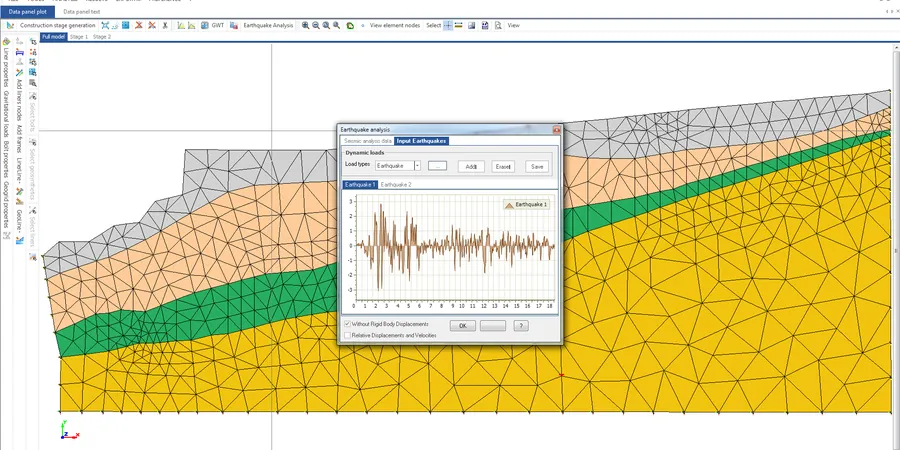
Measured Vs30 at a Turnagain borehole was 215 m/s (site class E), doubling the spectral acceleration at 1.5 s compared to code default.
Scope of work
- Shear-wave velocity profiling via MASW and downhole methods (ASTM D7400)
- Laboratory resonant column and cyclic triaxial tests on undisturbed samples
- Strain-compatible modulus reduction and damping curves by soil type
Area-specific notes
In Anchorage, many geotechnical reports still rely on the default ASCE 7 amplification factors for site class D or E. But the 2018 earthquake showed that long-period amplification in the Bootlegger Cove clay can exceed code factors by 40% at periods above 1.0 s. The risk is twofold: underestimating the spectral acceleration for the structural design, and misjudging the cyclic softening potential of the clay during the main shock plus aftershocks. A site response analysis in Anchorage that uses only the code spectra may miss the basin-edge focusing effects observed in the Government Hill and Fairview zones. We incorporate 2D basin geometry from existing NEHRP shear-wave velocity maps and check for topographic amplification near the Chugach foothills, where ridges can magnify PGA by 1.3 to 1.5 times.
Standards used
ASCE 7-22 Section 21.4 – Site-Specific Ground Motion Procedures, IBC 2021 Chapter 16 – Seismic Design Categories, ASTM D7400-19 – Downhole Seismic Testing, NCEER 1997 – Recommended Procedures for Site Response Analysis (Youd & Idriss)
Linked services
1D Equivalent-Linear Analysis (SHAKE/DeepSoil)
We develop shear-wave velocity profiles from MASW or downhole surveys, select input motions from the NGA-West2 and subduction databases, and run strain-compatible SHAKE analyses. Output includes acceleration time histories, response spectra at 5% damping, and maximum shear strain profiles. This method is cost-effective for preliminary design and works well for moderate strain levels (<1%).
Nonlinear Effective-Stress Analysis (FLAC / PLAXIS 2D)
For high-seismicity sites or soft clay profiles where strains exceed 1%, we perform fully coupled nonlinear analysis using the UBCSAND or PM4Sand constitutive models. Pore pressure generation, cyclic softening, and post-shaking shear strength reduction are explicitly modeled. This is the standard for critical facilities (hospitals, schools, fuel tanks) in Anchorage.
This service complements our laboratory testing work for a complete project analysis.
Typical parameters
Q&A
What is the typical cost range for a site response analysis in Anchorage?
The cost for a site response analysis in Anchorage typically falls between US$1,430 and US$4,090, depending on the depth of profiling, number of input motions, and whether nonlinear analysis is required. A basic 1D SHAKE study with 7 motions and a single borehole is at the lower end; a full nonlinear 2D study with liquefaction coupling is at the upper end. We will provide a firm quote after reviewing the project scope.
How does the Bootlegger Cove clay affect seismic amplification in Anchorage?
The Bootlegger Cove clay is a highly sensitive, low-stiffness marine deposit that can amplify long-period ground motions (1–2 s) by a factor of 2 to 3 compared to rock. Its low shear-wave velocity (150–250 m/s) places most sites in ASCE 7 site class E. Site response analysis in Anchorage must account for the strain-softening behavior of this clay, which reduces its modulus significantly at strains above 0.1%, prolonging the shaking duration.
What is the difference between a site response analysis and a standard seismic hazard study?
A probabilistic seismic hazard analysis (PSHA) gives the ground motion at a rock outcrop (typically Vs30 = 760 m/s). A site response analysis in Anchorage propagates those rock motions through the actual soil profile to the surface, accounting for soil stiffness, damping, and nonlinearity. PSHA alone cannot capture the amplification from the deep clay basins; site response analysis is required per IBC 2021 when the site class is D, E, or F, or when the structure is in Seismic Design Category D, E, or F.