The difference between building in downtown Anchorage versus the Hillside is night and day. Downtown sits on compact glacial till and outwash deposits that offer good bearing capacity. Up in the Hillside, you find colluvial soils over bedrock, often with ice-rich silt layers that shift under load. A soil mechanics study in Anchorage must account for these contrasts because a foundation design that works near Ship Creek would fail spectacularly on a South Fork hillside lot. We have drilled test pits and boreholes across both zones, correlating blow counts with local frost depth data so your project gets a realistic soil model from the start. The variability is high, but proper sampling catches it.
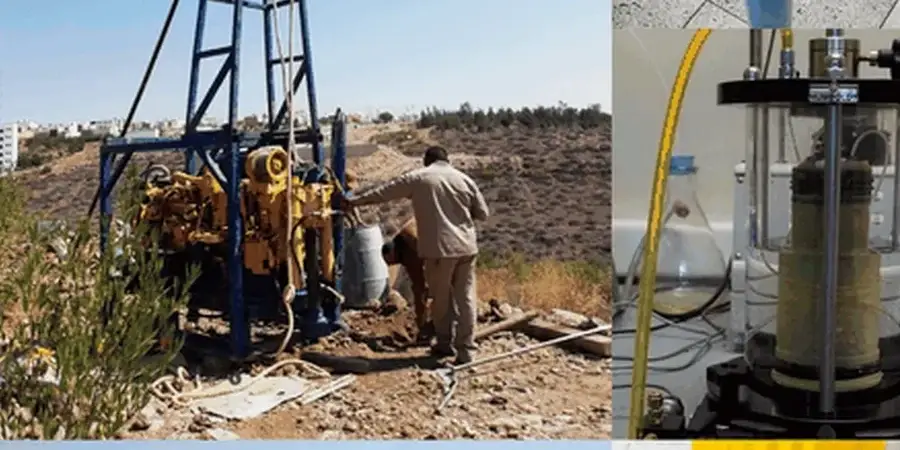
Anchorage soils can change from dense gravel to ice-rich silt within 3 m — one borehole per corner is not enough.
Scope of work
Area-specific notes
Anchorage sits at latitude 61.2° N with a mean annual temperature of 36°F, but the real risk lies underground. The 1964 Good Friday earthquake (M9.2) triggered widespread liquefaction and lateral spreading in the Turnagain Arm area, destroying dozens of homes. A proper soil mechanics study in Anchorage evaluates liquefaction potential using the NCEER method (Youd-Idriss 2001) for every site within 2 km of the coast or the Knik Arm. We also assess thaw settlement risk in permafrost zones, which can exceed 30 cm under a heated structure if the thermal regime is not controlled. Ignoring these hazards means footing rotation, slab cracking, or worse.
Standards used
ASTM D1586-18 (SPT), ASTM D2487-17 (classification), IBC 2021 Chapter 18 (foundations), ASCE 7-22 (seismic site class, liquefaction)
Linked services
Field Exploration and Sampling
Boreholes with SPT, Shelby tube sampling, test pits, and CPT soundings. We map permafrost depth, ice lenses, and groundwater levels in real time.
Laboratory Testing Program
Moisture content, Atterberg limits, grain size analysis, triaxial compression, and consolidation. All tests run in our ISO 17025 accredited lab.
Geotechnical Analysis and Recommendations
Bearing capacity, settlement, liquefaction, thaw consolidation, and slope stability. We deliver a design report with foundation options and construction considerations.
Typical parameters
Q&A
How much does a soil mechanics study cost in Anchorage?
For a typical single-family lot, the study ranges between US$3,050 and US$5,010 including field work, lab tests, and the report. Larger commercial sites with multiple boreholes and advanced testing can run higher.
What is the difference between N-SPT and CPT for Anchorage soils?
N-SPT gives you blow counts and disturbed samples for classification; it is reliable in gravelly till. CPT provides continuous cone resistance and pore pressure readings, ideal for detecting thin ice lenses or soft silt layers that SPT might miss. We often run both on complex sites.
Do I need a permafrost evaluation for a house in Anchorage?
Yes if your lot is in the Hillside, Eagle River, or any area with organic mat and shallow ice. The soil mechanics study includes a thermal analysis and active layer depth measurement. If permafrost is present, we recommend insulated foundations or thermosyphons.
How long does the study take from start to finish?
Field drilling and sampling usually take 1 to 3 days depending on access and depth. Lab testing runs 2 to 4 weeks for consolidation and triaxial. The full report is ready within 4 to 6 weeks from the start of field work.