We were called to a site off Northern Lights Boulevard where a new commercial slab had settled 15 cm in one week after the first heavy rain. The client had assumed the glacial till was competent, but a thin layer of windblown loess sat just below the footing grade. Collapsible soil evaluation in Anchorage is critical because our valley floor contains both silt-loess and ice-contact deposits that can lose up to 10% of their volume when wetted under load. Before we pour any foundation here, we run double-ring oedometer tests at natural moisture content and after flooding. The collapse potential index from ASTM D5333 tells us whether the soil structure is metastable. For deeper profiles we pair this with a consolidation analysis to separate collapse from normal consolidation settlement.
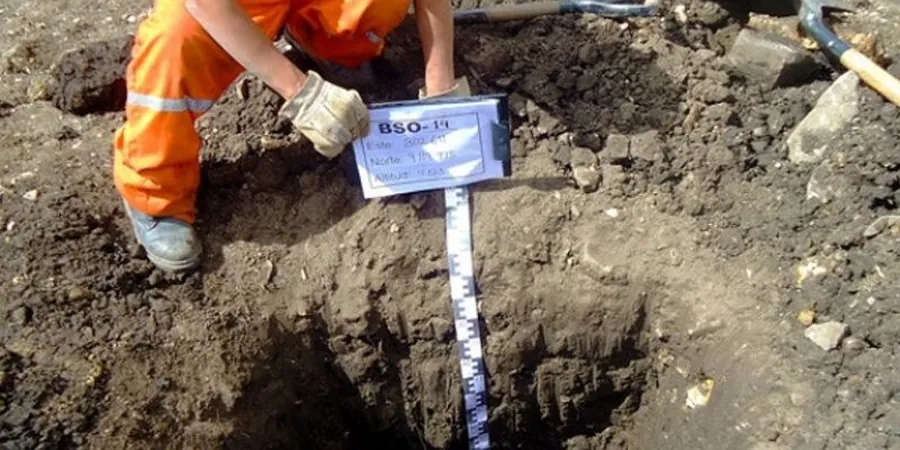
A collapsible soil evaluation in Anchorage can reveal a collapse strain of 8% or higher in the same silt you thought was stable.
Scope of work
Area-specific notes
The most common mistake we see is contractors assuming that because the soil looks dense during excavation, it will stay that way. In Anchorage, the silt-loess can stand vertically in a trench wall, giving a false sense of competence. When the foundation load is applied and water infiltrates—from rain, snowmelt, or a broken utility—the soil structure collapses instantly. We have documented cases where a 10 cm settlement occurred overnight. Skipping a proper collapsible soil evaluation in Anchorage leads to cracked slabs, jammed doors, and structural repairs that cost more than the original test. A simple oedometer test per ASTM D5333 prevents that risk.
Standards used
ASTM D5333 – Standard Test Method for Measurement of Collapse Potential of Soils, ASCE 7-22 – Minimum Design Loads (Section 2.4 for hydrostatic and flood effects), ASTM D2435 – Standard Test Methods for One-Dimensional Consolidation Properties of Soils, ASTM D1586 – Standard Test Method for SPT and Sampling of Soils
Linked services
Double-Ring Oedometer Testing
Two identical specimens from the same thin-wall tube, one tested at natural moisture and one flooded under the same stress increments. We measure collapse strain at 50, 100, 200, and 400 kPa.
Continuous Flight Auger Sampling
We drill with hollow-stem augers and take undisturbed thin-wall samples every 0.75 m in the silt layer. This captures the natural void ratio and prevents disturbance that could mask collapse behavior.
In-Situ Collapse Index (Field Flood Test)
For existing fills or compacted silts, we use a plate load test with a ponded ring. The plate is loaded to 200 kPa, then the area is flooded for 24 hours. The measured settlement under constant load gives a field collapse index.
Mitigation Design Recommendations
Based on the collapse potential profile, we recommend either deep compaction (vibroflotation), pre-wetting, or foundation over-design. For severe cases we suggest replacing the collapsible layer with well-graded gravel.
This service complements our laboratory testing work for a complete project analysis.
Typical parameters
Q&A
How much does a collapsible soil evaluation in Anchorage cost?
The typical range for a residential or small commercial evaluation is US$830 – US$2,510, depending on the number of test pits, oedometer specimens, and field flood tests. Larger sites with multiple boreholes can exceed this range.
What is the collapse potential of Anchorage's glacial silt?
Anchorage's glacial and loessial silts typically show a collapse strain between 2% and 8% under a 200 kPa load. The collapse potential index per ASTM D5333 ranges from slight (0.5%) to severe (8%). The highest values are found in areas like Spenard and Turnagain where windblown loess caps the older deposits.
Can I build on collapsible soil without mitigation?
Not safely. If the collapse strain exceeds 2% under the design load, the slab or footing will likely settle unevenly within the first year after construction. We have seen houses in Anchorage develop floor cracks and binding doors within 18 months because the collapsible silt was left untreated. Mitigation such as pre-wetting, compaction grouting, or removal is standard practice.
How long does the oedometer test take?
A double-ring oedometer test on a single depth requires 7 to 10 days. Each stress increment takes 24 hours to reach primary consolidation, and we run six increments per specimen. The flooded specimen adds one additional increment at the same stress. For a full evaluation with three depths, expect 3 to 4 weeks total.