Designing foundations in Anchorage means dealing with ground conditions that shift from frozen silt to dense glacial till within a single lot. The IBC and ASCE 7 both require a verified bearing value before slab-on-grade or shallow footing placement, and the plate load test (PLT) is the most direct way to obtain it. Anchorage sits on the Chugach Terrane, where surface soils often hide ice-rich permafrost lenses left from the last glaciation. Running a PLT at planned footing depth gives you a real-time modulus of subgrade reaction, not an estimate from a correlation. Pairing this test with a proper study of mechanical soil properties helps confirm whether the bearing layer will behave uniformly under load, especially in areas where thaw settlement is a known risk.
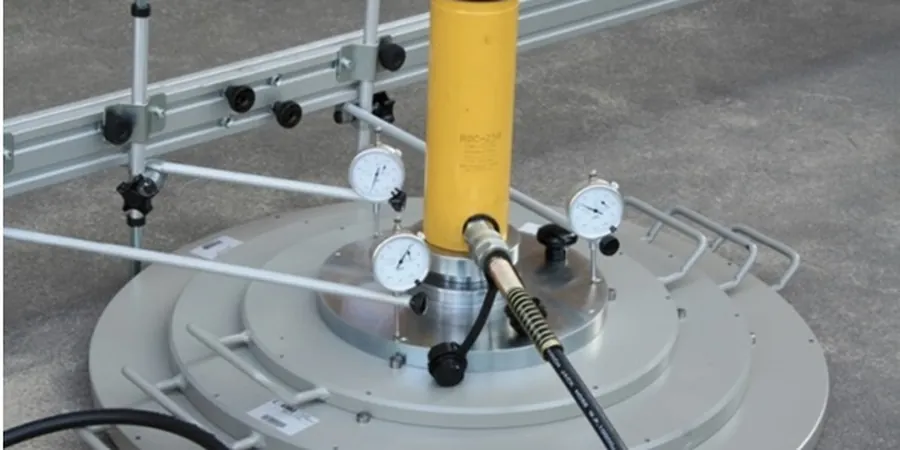
A properly executed PLT at planned footing depth reveals the real modulus of subgrade reaction, not an estimate from correlations.
Scope of work
Area-specific notes
The hydraulic jack and reaction frame used for a PLT in Anchorage must be set up on stable ground, often on the same frozen silt layer being tested. If the reaction load is taken from a weighted truck or concrete blocks, those blocks can settle or tilt during the test on thawing ground, skewing the settlement readings. Another real risk: testing too close to the surface in the active layer of permafrost gives a false high k-value, because the frozen crust is stiff but the thawed soil underneath will consolidate later. We always set the test depth at least 1.5 times the plate diameter below any disturbed surface soil, and we monitor ground temperature at test depth to confirm whether the soil is truly frozen or partially thawed.
Watch how it works
Standards used
ASTM D1196-21 (Standard Test Method for Nonrepetitive Static Plate Load Tests of Soils and Flexible Pavement Components), ASTM D2487-17 (Standard Practice for Classification of Soils for Engineering Purposes), IBC 2021 Chapter 18 (Soils and Foundations – bearing capacity verification)
Linked services
Standard PLT for Shallow Foundations
Single-plate test at planned footing depth for residential or light commercial projects. Includes load-settlement curve and k-value report per ASTM D1196.
Cyclic PLT for Elastic Modulus
Multiple loading/unloading cycles to determine elastic (rebound) modulus and plastic settlement. Useful for pavement design or crane pads on Anchorage's soft silt layers.
PLT on Permafrost Active Layer
Controlled test with ground temperature monitoring. Designed for projects where thaw depth varies seasonally. Report includes bearing capacity for both frozen and thawed conditions.
Typical parameters
Q&A
What is the difference between a PLT and an SPT for bearing capacity in Anchorage?
An SPT (standard penetration test) gives a blow count (N-value) that you correlate to bearing capacity through empirical charts. A PLT actually loads the ground and measures settlement directly. In Anchorage, where frozen silt and glacial till can have very different stress-strain behavior, the PLT eliminates the uncertainty of correlations. For example, a frozen silt layer might show N=30 but actually settle 0.4 inches under a 3,000 psf load, while the correlation would predict only 0.1 inches.
How deep should the test plate be placed in permafrost zones?
At least 1.5 times the plate diameter below any disturbed surface soil, and ideally below the active layer depth expected during construction. For Anchorage, that usually means 3 to 5 feet deep. If the active layer is 4 feet thick in summer and you place the plate at 2 feet, you are testing frozen crust that will thaw later, giving a false high k-value.
What is the typical cost of a plate load test in Anchorage?
For a standard single-plate test including mobilization, setup, and a full report, expect between US$900 and US$1,160. Cyclic or permafrost-specific tests add a bit more due to extra time and thermal monitoring. Volume discounts apply for multiple test locations on the same site.
Can a PLT be performed on gravel or rocky ground in Anchorage?
Yes, but the plate surface must be level and in full contact with the soil. On coarse gravel or cobbles, a thin layer of fine sand is used to seat the plate. For very rocky ground (e.g., glacial till with boulders), the test may not give reliable results because the plate bears on individual stones rather than the matrix. In those cases, a falling weight deflectometer or CBR test might be more appropriate.
What information do you need from me to schedule a PLT?
We need the planned footing depth, approximate test location on site, any known ground conditions (frozen, wet, etc.), and the maximum load or bearing pressure you want to verify. Also let us know if you need the test during frozen season or after thaw, because temperature affects the results. We handle the mobilization and setup.