Anchorage sits on a mix of glacial till, silty clays, and marine deposits. Much of the city, particularly around the Ship Creek valley and Turnagain Arm, contains soft, saturated clays that are highly sensitive to disturbance. The unconfined compression test (UCS) provides a fast, reliable measure of undrained shear strength for these cohesive layers. It is a routine step for shallow foundation design and slope stability checks. In our experience, the UCS data often reveals strength values lower than what local contractors expect, especially in the Bootlegger Cove Clay formation. That is why we always recommend pairing the UCS with a density cone test when verifying compaction in fills, or a direct shear test for long-term drained parameters on the same boring log.
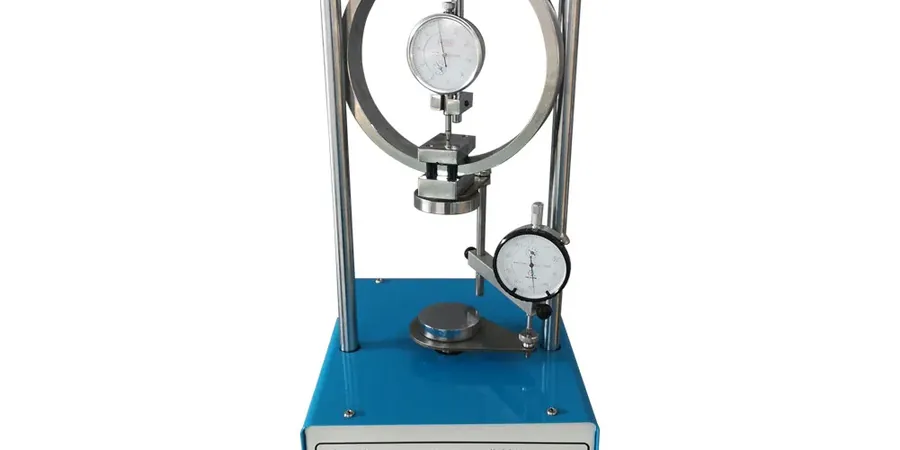
Bootlegger Cove Clay in Anchorage can show qu values under 0.5 kg/cm², making the UCS critical for foundation design in the Turnagain area.
Scope of work
Area-specific notes
The most common mistake we see in Anchorage is assuming the undrained strength from a nearby boring applies to your site. The glacial till can change from stiff to soft within 10 meters. If a contractor skips the UCS and uses a generic qu value, the foundation may settle more than expected. Another risk is testing a disturbed sample. A cracked or dried specimen yields a qu that is 30 to 50 percent lower than the real value. That leads to overdesigned footings and wasted concrete. Do not guess. Test the actual clay from your own borehole.
Watch how it works
This service complements our laboratory testing work for a complete project analysis.
Standards used
ASTM D2166-16, ASTM D1587-15 (thin-walled tube sampling), IBC 2021 Section 1806 (presumptive load-bearing values)
Linked services
Thin-walled tube sampling
Shelby tube extraction per ASTM D1587. Minimizes disturbance in soft clays. Sealed and shipped to lab same day.
UCS on undisturbed samples
Full stress-strain curve, qu, and Su. Report with strain at failure and failure mode.
Index tests on cohesive soils
Natural moisture content, unit weight, and Atterberg limits on the same boring sample.
Combined UCS + consolidation
One sample used for both UCS and one-dimensional consolidation. Saves time and cost on soft clay projects.
Typical parameters
Q&A
What is the difference between UCS and triaxial compression?
UCS applies no confining pressure. It measures the undrained strength of cohesive soil under zero lateral stress. Triaxial tests apply a confining pressure to simulate in-situ stress conditions. UCS is faster and cheaper but only valid for saturated clays where the undrained assumption holds.
How much does an unconfined compression test cost in Anchorage?
The typical range for a single UCS test in Anchorage is between US$360 and US$470. This includes sample preparation, loading, and a report with the stress-strain curve. Volume discounts apply for 10 or more specimens from the same project.
Can UCS be used for slope stability analysis in Anchorage?
Yes, but only for short-term undrained conditions. The Bootlegger Cove Clay often controls stability in the Turnagain bluffs. UCS provides the qu needed for limit equilibrium methods. For long-term drained analysis, we recommend direct shear or triaxial CU tests instead.