A common mistake we see in Anchorage projects is assuming the subgrade behaves uniformly across the site. One stretch might be dense glacial till, while fifty feet away you hit ice-rich silt or peat lenses. Skipping a detailed pavement investigation leads to differential settlement and premature cracking within two years. Our road geotechnics approach starts with shallow test pits and dynamic cone penetration to map variability before any design begins. We then correlate that data with local frost depth records and drainage patterns to define realistic subgrade moduli. For projects on soft ground, we often recommend combining this with a georradar survey to detect buried ice or organic layers without digging everywhere. The goal is a pavement section that matches the actual ground, not a generic catalog section.
In Anchorage, frost heave and thaw weakening control pavement performance more than traffic loads alone. Subgrade characterization must account for freeze-thaw cycles directly.
Scope of work
Area-specific notes
We worked on a collector road rehabilitation along the Seward Highway corridor where the original pavement had been placed directly on organic silt. Within three winters, the surface developed longitudinal cracks and step faults up to four inches high. The owner had skipped a proper subgrade investigation and used a standard section from a manual. We cored the pavement and found the base course had pumped silt from below, and the subgrade had lost 60% of its strength during spring thaw. The fix required full-depth reclamation with cement stabilization and a capillary break layer. That project cost triple what a proper road geotechnics study would have added upfront. In Anchorage, ignoring freeze-thaw behavior is the fastest way to turn a road into a maintenance headache.
Standards used
ASTM D1883 (CBR test), AASHTO T-307 (Resilient modulus of soils), ASTM D698 / D1557 (Proctor compaction), AASHTO 1993 / Mechanistic-Empirical Pavement Design Guide, U.S. Army CRREL Frost Susceptibility Classification
Linked services
Subgrade Investigation and Classification
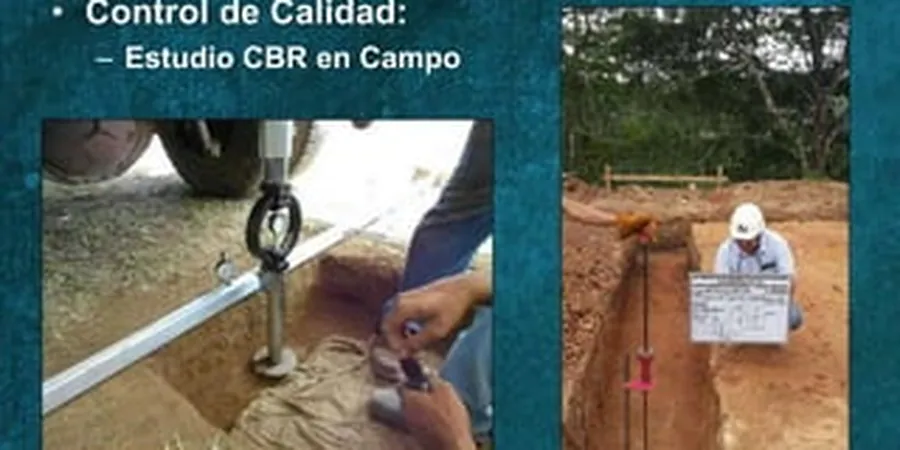
Test pits and boreholes to classify soil types, measure density and moisture, determine CBR, and assess frost susceptibility. We provide a subgrade modulus profile for each pavement section.
Pavement Structural Design
Construction Quality Control and Verification
On-site density testing with nuclear gauge or sand cone, proof rolling, and compaction monitoring. We verify that the subgrade and base courses meet the specified modulus and density before paving.
Typical parameters
Q&A
How does frost heave affect pavement design in Anchorage?
Frost heave occurs when ice lenses form in frost-susceptible soils during winter, lifting the pavement unevenly. During spring thaw, the ground becomes oversaturated and loses strength, causing rutting and cracking. Our design includes a non-frost-susceptible base layer thick enough to prevent ice lens formation and a drainage system to evacuate meltwater quickly.
What is the typical cost range for a road geotechnics study in Anchorage?
For a typical project, the cost ranges between US$780 and US$4,100 depending on the number of test pits, laboratory tests, and the complexity of the design. A full investigation for a subdivision road usually falls in the middle of that range.
What tests are essential for subgrade characterization in cold regions?
Key tests include the CBR test (ASTM D1883) for strength, resilient modulus (AASHTO T-307) for pavement design, soil classification (ASTM D2487), and Atterberg limits (ASTM D4318) to identify frost-susceptible fine-grained soils. We also recommend a grain size analysis to check the percent passing the No. 200 sieve, which correlates with frost heave potential.
How long does a pavement design study take from start to finish?
A standard road geotechnics study for a one-mile stretch typically takes 2 to 4 weeks. This includes field work (2-3 days), laboratory testing (1-2 weeks), and report writing with pavement section recommendations (3-5 days). Urgent projects can be expedited by running tests in parallel.